Confrontatie is de weg naar een betere wereld
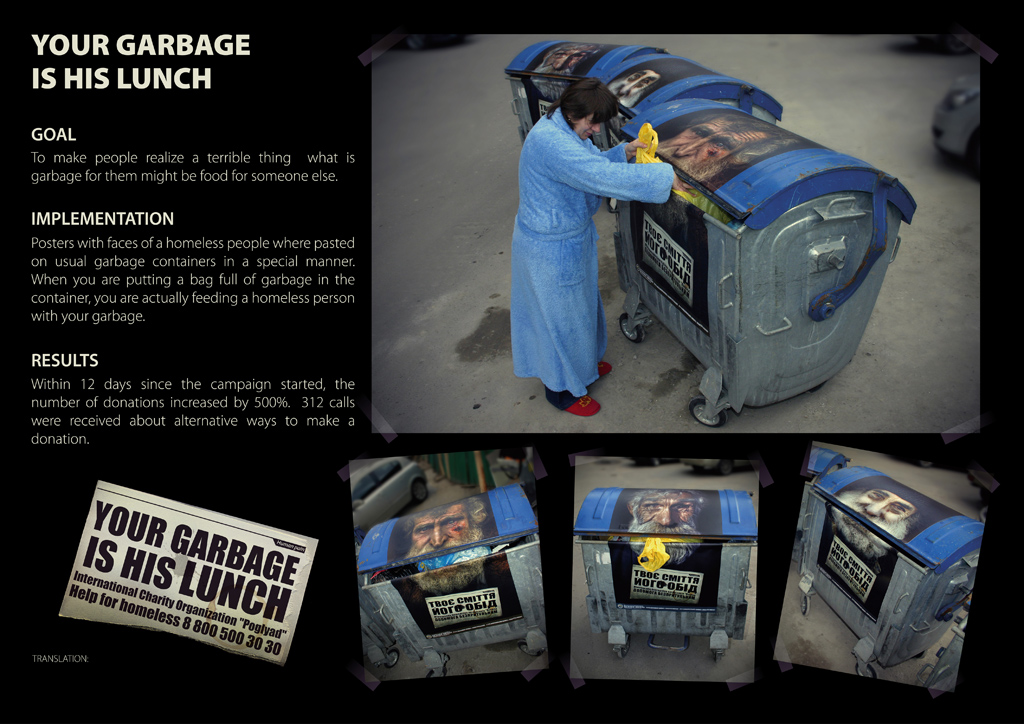 ‘Uw afval is zijn lunch’, dat is de boodschap van liefdadigheidsorganisatie Poglyad aan de inwoners van Oekraïne en Wit-Rusland. Poglyad is onlangs een guerrillacampagne gestart om begrip op te brengen voor de erbarmelijke situatie van de vele daklozen in de voormalige Sovjetrepublieken. Poglyad heeft vele containers beplakt met een foto van een dakloze waarbij de mond ter hoogte van de containerklep zit. Het uiterst confronterende effect is dat de nietsvermoedende burger zijn of haar afval in de mond gooit van een dakloze. Hiermee wordt de burger pijnlijk bewust gemaakt van het feit dat ‘hun afval zijn lunch is’.
Prachtig, maar werkt het ook? Jazeker, de donaties aan Poglyad stegen binnen twaalf dagen met 500% en Poglyad ontving ruim 300 telefoontjes over alternatieve manieren om te helpen.
Poglyad laat hiermee nog maar eens zien dat het voor velen ‘vieze woord’ marketing de weg kan zijn naar een betere wereld. Bovendien is het duidelijk dat de kracht van guerrillamarketing ook door Oost-Europa is opgepikt. Maar de belangrijkste les die uit deze campagne te trekken valt is dat confrontatie werkt. En dat was voor ons niets nieuws, want Spotlight Effect zei al eerder vaarwel tegen subtiliteit in voorlichting.


Prachtig gevonden.
In de VS confronteren ze het publiek vaak op schokkende wijze. Ik vind nog steeds dat ze dat goed doen, maar af en toe gaan ze te ver.
Zo keek ik weg zodra de anti-rookreclame op tv kwam. Een man had door het roken longkanker gekregen. Als gevolg daarvan had hij een gat in zijn keel. Als je benieuwd bent hoe hij dat gat schoonhoudt, kijk dan naar de Amerikaanse tv!
… of dat ventje op de Amerikaanse tv die (zogenaamd? als we Southpark mogen geloven in ieder geval wel) zijn opa aan roken heeft verloren en nu een hoop mist in zijn leven. Ik vind het geen slechte manier van bewust maken. Ik reed laatst op een soort landweg in Limburg en daar stond letterlijk iets van ‘rij hier te hard en je rijdt jezelf dood’. Meteen een soort schokeffect, doet meer dan die ludieke slogans in België: ‘U staat stil op de pechstrook… want u wacht op de ware’ en ‘U rijdt wild want uw opa was piraat?’. Doe dan gewoon wat aan je wegdek. Maar nu dwaal ik af.
@ Ernst-Jan: Goed punt, wilde eigenlijk nog de gedachte achter dit artikel toevoegen:
http://peterevers.wordpress.co.....e-condoms/
“Maar de belangrijkste les die uit deze campagne te trekken valt is dat confrontatie werkt.”
Waar gaat dit over? Doen jullie je huiswerk niet? Dat de leider en oprichter van Poglyad toevallig een een Amerikaanse Adventist in Washington is, is zeker niet belangrijk te vermelden?
@ Sonja: Dat wist ik niet en ik moet zeggen dat ik er ook niets over kan vinden. Het zal op hun Russische site te vinden zijn, helaas kan ik geen Russisch lezen. Wat is zijn naam? En doet het niet vermelden van dit feit werkelijk af aan dit artikel?
Beste Peter, ik heb even gegoogled en meteen gevonden (en dubbelgechecked). Dat doe ik altijd meteen wanneer ik denk dat er meer aan de hand is dat een simpel spontaan volksprotest. Het is zeer zeker belangrijk om dit erbij te vermelden, aangezien alle volksprotesten en ‘oranje revoluties’ e.d. in die contreien worden gefinancierd en naar mijn mening ook georganiseerd door Amerika (CIA). Hetzelfde doen ze, en dat is geen geheim, over de hele wereld. Maar door dat erbij te zetten informeer je de lezer beter. Natuurlijk, de commerciële masamedia hoor je niet over, maar die zijn het ook gewoon geworden om ‘nieuws’ te brengen zonder context en achtergrondinformatie. Hypes en zo.
“This program features an interview with Henry Johnson, founder of Poglyad.”
http://www.sdalaw.org/radio.asp
“Two students members of Poglyad”
“The students mentioned are Henry Johnson (left) and Gene Groom, both freshman at Columbia Union College.”
“This is yet another example of the kind of thing you can’t do at just any Adventist college.”
http://cucblog.blogspot.com/20.....cracy.html
“As said by the leader of “Poglyad” Henry Johnson”
http://www.charter97.org/eng/news/2007/03/19/mart
Het gaat hier dus om een Amerikaanse beweging, laat dat duidelijk zijn.
@sonja “het is zeer zeker belangrijk om dit erbij te vermelden, aangezien alle volksprotesten en ‘oranje revoluties’ e.d. in die contreien worden gefinancierd en naar mijn mening ook georganiseerd door Amerika (CIA). Hetzelfde doen ze, en dat is geen geheim, over de hele wereld.”
Ehm, mag ik hier even de bron voor?
Misschien moet ik eerst even uitleggen wat de CIA is, en hoe die opereert? Zeg het maar hoor, dan ga ik daar eerst mee beginnen, is wel zo handig.
Goed, ik beperk het nu even tot hoofdzakelijk Belarus.
———————————————-
US campaign behind the turmoil in Kiev
Ian Traynor
Friday November 26, 2004
The Guardian
With their websites and stickers, their pranks and slogans aimed at banishing widespread fear of a corrupt regime, the democracy guerrillas of the Ukrainian Pora youth movement have already notched up a famous victory – whatever the outcome of the dangerous stand-off in Kiev.
(…)
But while the gains of the orange-bedecked “chestnut revolution” are Ukraine’s, the campaign is an American creation, a sophisticated and brilliantly conceived exercise in western branding and mass marketing that, in four countries in four years, has been used to try to salvage rigged elections and topple unsavoury regimes.
(…)
Funded and organised by the US government, deploying US consultancies, pollsters, diplomats, the two big American parties and US non-government organisations, the campaign was first used in Europe in Belgrade in 2000 to beat Slobodan Milosevic at the ballot box.
(…)
But experience gained in Serbia, Georgia and Belarus has been invaluable in plotting to beat the regime of Leonid Kuchma in Kiev.
The operation – engineering democracy through the ballot box and civil disobedience – is now so slick that the methods have matured into a template for winning other people’s elections.
(…)
In Belarus, the US embassy organised the dispatch of young opposition leaders to the Baltic, where they met up with Serbs travelling from Belgrade. In Serbia’s case, given the hostile environment in Belgrade, the Americans organised the overthrow from neighbouring Hungary – Budapest and Szeged.
(…)
The Democratic party’s National Democratic Institute, the Republican party’s International Republican Institute, the US state department and USAid are the main agencies involved in these grassroots campaigns as well as the Freedom House NGO and billionaire George Soros’s open society institute.
(…)
In Belarus, US officials ordered opposition parties to unite behind the dour, elderly trade unionist, Vladimir Goncharik, because he appealed to much of the Lukashenko constituency.
(…)
Freedom House and the Democratic party’s NDI helped fund and organise the “largest civil regional election monitoring effort” in Ukraine, involving more than 1,000 trained observers. They also organised exit polls. On Sunday night those polls gave Mr Yushchenko an 11-point lead and set the agenda for much of what has followed.
(…)
In Belarus, President Lukashenko won, so the response was minimal. In Belgrade, Tbilisi, and now Kiev, where the authorities initially tried to cling to power, the advice was to stay cool but determined and to organise mass displays of civil disobedience, which must remain peaceful but risk provoking the regime into violent suppression.
If the events in Kiev vindicate the US in its strategies for helping other people win elections and take power from anti-democratic regimes, it is certain to try to repeat the exercise elsewhere in the post-Soviet world.
The places to watch are Moldova and the authoritarian countries of central Asia.
http://www.guardian.co.uk/ukra.....36,00.html
——————–
US Ambassador admits Washington is subverting the Belarus presidential election
The United States has launched a massive campaign to subvert the September 9th Belarusian presidential election in a effort to topple President Alexander Lukashenka, who has been moving slower on “free market reforms” than Washington would like. And Washington is using a strategy similar to one it used to oust the Nicaraguan Sandinista government in the 80′s, and to depose Slobodan Milosevic in Yugoslavia last year.
The campaign, which involves funneling money to non-governmental agencies (NGO’s) opposed to Lukashenka, a youth group reminiscent of the US-backed Serb resistance group that was instrumental in toppling Slobodan Milosevic, and Radio Free Europe broadcasts urging Belarusians to vote for Lukashenka’s US-backed opponent, was revealed by the US Ambassador to Belarus, Michael Kozak.
Nicknamed “the weasel” by former CIA director William Casey, Kozak served as Principal Deputy Assistant Secretary for Inter-American Affairs, working in Panama and El Salvador in the 80′s, and in Nicaragua at a time Washington was employing various shady and illegal means to topple the Sandanistas, including illegally funneling money to the Contras. In a startling letter to a British newspaper, Kozak revealed last week that Washington’s “objective and to some degree methodology are the same” in Belarus as in Nicaragua, sparking fears that Washington is prepared to up the ante if Lukanshenka wins the September 9th election.
(…)
Key to Washington’s campaign against Lukashenka in the West is portraying the Belarusian president as a repressive tyrant, an ominous sign that the White House may be softening Western public opinion for more drastic measures should Lukashenka win the election. But the BHHRG says that “opposition criticism of Lukashenka’s Belarus lays the emphasis on matters such as foreign investment and the need to move closer to the Western mainstream,” not human rights abuses or political repression. Political repression is a Washington invention.
Writing in the American Spectator, Daniel McAdams says that Washington’s real beef with Lukashenka is that he hasn’t moved fast enough on economic reforms, not his human rights abuses, which are grossly exaggerated, even fabricated, and, even if they were real, are hardly different from those of former Russian President Boris Yeltsin, who Washington supported. McAdams points out that the usual complaint about Lukashenka is that he abolished the parliament, cheats on elections, and is autocratic. But Boris Yeltsin ruled almost exclusively by decree, cheated on every election, and blew up a parliament he didn’t like. Argues McAdams, the difference between Yeltsin, the admired reformer, and Lukashenko, smeared as an autocrat, is that Yeltsin was enthusiastic about embracing the free market, while Lukashenka’s passions for free market reforms have proved less than overwhelming.
(…)
Apart from the infamous intervention of Washington into the electoral affairs of Chile, the US has intervened in numerous elections to assure that its operating principle prevails: we’ll accept the outcome of democracy, just as long as it’s agreeable to America’s vital interests, vital interests being a vague, but high-sounding phrase, that reduces to: our right to economically dominate any part of the world we choice, which these days, on top of the Balkans, includes Belarus.
http://www.mediamonitors.net/gowans25.html
—————————–
Tucked away in between Poland, Lithuania, Latvia, the Ukraine and Russia, lies Belarus, a former Soviet republic, and home, if The New York Times is to be believed, to a repressive, Soviet-era style police state, where the opposition is intimidated by the secret police, and whose president rules with an iron-fist and steals elections. A thoroughly unsavory place, likened to Milosevic’s Yugoslavia. But scratch the surface and it’s clear that media depictions of Belarus, like those of Serbia and Milosevic, are bumf, a handy cover for US meddling in the affairs of a sovereign country.
What prompts US meddling, now, as much as ever, is not contempt for civil liberties, or ethnic repression, or democratic lapses, but an unwillingness to fully embrace free trade and open markets. Writer Samuel Huntingdon, describes US foreign policy as designed to “promote American corporate interests under the slogans of free trade and open markets; shape World Bank and IMF policies to serve those same corporate interests;…bludgeon other countries to adopt economic and social policies that will benefit American economic interests; promote American arms sales abroad…and categorize certain countries as ‘rogue states,’ excluding them from global institutions because they refuse to kowtow to American wishes.” (1)
The United States undertook a massive campaign to subvert the September 9th Belarusian presidential election, but failed to topple Lukashenko. He won the election with a resounding majority. Washington’s dump-Lukashenko campaign consisted of funnelling money to non-governmental agencies (NGO’s) opposed to the Belarusian president, a youth group reminiscent of the US-backed Serb resistance group that was instrumental in toppling Slobodan Milosevic, and Radio Free Europe broadcasts urging Belarusians to vote for Lukashenko’s US-backed opponent.
The British Helsinki Human Rights Group (BHHRG), which sent observers to Belarus, disputes the charge that the former Soviet republic is less open than the besieged Caribbean island. Belarus has multi-party elections, allows the opposition access to the media, and permits foreign human rights monitors into the country, all points the press has taken to obscuring in the wake of Lukashenko’s victory. Cuba allows none of these things. And Cuba hasn’t allowed an American General into the country since 1959, yet Belarus allowed NATO Supreme Allied Commander General Joseph Ralston to visit the country on July 23 to address a press conference critical of Lukashenko. And while Cuba regularly jams US-sponsored anti-Castro Radio Marti broadcasts, anti-Lukashenko Radio Free Europe broadcasts go unchallenged.
Moreover, says the human rights group, “even President Lukashenko’s most vehement opponents refused to characterize him as a tyrant or dictator, and none of the President’s critics alleged even a significant degree of repression in society in general.” (6)
US-sponsored anti-Lukashenko Radio Free Europe broadcasts were stepped-up during the election period, backing up an already substantial collection of US-funded NGO’s arrayed against the Belarusian president. A spokesperson at the US Embassy in Minsk told The (London) Times that the embassy helped to fund 300 NGOs, including media, many of which are opposed to Lukashenko. And a youth group, Zubr, bearing a uncanny resemblance to Otpor, the anti-Milosevic student group trained and funded by Washington, had put up stickers portraying Lukashenko as a criminal. Otpor sent its fraternal greetings to Zubr on the day of the election.
http://www.swans.com/library/art7/gowans06.html
—————————————-
The Times
3 September 2001
US adopts ‘Contras policy’ in communist Belarus
THE US Embassy in Belarus has admitted that it is pursuing a policy similar to that in 1980s Nicaragua, in which anti-government Contra rebels were funded and supported.
President Lukashenko, a dictatorial Communist, is heading for victory in presidential elections on Sunday.
In an unusual admission, Michael Kozak, the US Ambassador to Belarus, said in a letter to a British newspaper that America’s “objective and to some degree methodology are the same” in Belarus as in Nicaragua, where the US backed the Contras against the left-wing Sandinista Government in a war that claimed at least 30,000 lives. Mr Kozak was not available for comment.
Washington said recently that allegations of state-sanctioned death squads operating in Belarus, Europe’s last bastion of communism, were “credible”. Two former state prosecutors, who have been granted political asylum in America, have said that victims were murdered with a special pistol and buried in a cemetery in Minsk.
http://emperors-clothes.com/news/tough.htm
—————————————–
Wat leren we hieruit? Laat je niets wijsmaken, zeker niet door de commerciële massamedia, en onderzoek de zaak eerst.
Reclaiming the “Orange Revolution”
Since the demonstrations which reversed the electoral decision in the Ukraine, I’ve heard and seen many Ukrainians talking about large groups of foreigners who were pivotal to their planning. Many of these groups were the ones responsible for paying for the food, shelter, and orange banners used by the protestors. I didn’t think much of this, or the accusations of funding from agencies such as the CIA, until I saw the same thing occurring in Lebanon.
Then, a reporter for the Canadian Broadcasting Corporation, Carol Off, did a piece explaining that the “spontaneous, grassroots” protests in the Ukraine were the result of CIA funding and planning over a period of ten years.
http://www.dissidentvoice.org/.....on0918.htm
——————-
1. An excellent source for an informed perspective was the presentation of Michael McFaul (associate professor of political science at Stanford University; senior associate at the Carnegie Endowment for International Peace; Peter and Helen Bing senior fellow at the Hoover Institution; research associate at the Centre for International Security and Co-operation and the Centre for Democracy, Development, and the Rule of Law, both at Stanford; and senior advisor to the National Democratic Institute; former senior associate in residence at Carnegie’s Moscow Centre; and other important roles and advisory positions including being a key member of the US National Security Council, advising a number of US presidential administrations) at the academic conference “Ukrainian Presidential Elections of 2004 in Comparative Perspective”, held at the Munk Centre for International Studies, University of Toronto, 21 January 2004 (for the program: http://www.utoronto.ca/jacyk [4]; for an mp3 file of Prof. McFaul’s talk: http://www.utoronto.ca/jacyk/a.....McFaul.mp3 [5]: for an mp3 file of the Q&A after the presentations: http://www.utoronto.ca/jacyk/a.....#038;A.mp3 [6]); he made many interesting points:
a. Contrary to Carol Off’s contention that the Orange Revolution in Ukraine is a “carbon copy” of those in Serbia and Georgia, McFaul details not only the shared features, but more significantly the important and critical differences that separate the events in Serbia, Georgia and Ukraine.
b. US funding, like that from the EU and Canada (through CIDA), was directed primarily at “civil society” programs that were distributed to many political parties (including Yanukovych’s Party of Regions) and many non-partisan groups (like the Ukrainian Scouting program that I was a part of for a few years in Ukraine – very sinister, indeed!).
c. US involvement in Ukraine was, in comparison to Serbia for example, highly restricted because at a very “high level” in the US administration “there was real ambiguity about what to do” because of Kuchma’s clever co-operation with the Bush administration in Iraq and that administration’s special relationship with Putin and Russia.
d. While the US and other western countries wanted and achieved “valuable connectivity,” that doesn’t translate into control and the ability to direct.
2. At the same conference it was also pointed out by Prof. Paul D’Anieri (University of Kansas) that “Ukraine did not need US help.” (http://www.utoronto.ca/jacyk/a.....Anieri.mp3 [7])
3. An Agence France-Presse wire story (http://www.thestandard.com.hk/.....7Dh02.html [8]) “Business Bankrolled Orange Revolution;” outlines how most of the money for the revolution (along with the food and organizational skills) was basically Ukrainian and not foreign.
4. This article, from the Russian language business magazine Kommersant (http://www.kommersant.com/page.asp?id=546044 [9]) “Fathers of Ukrainian Democracy Found in Washington Suburb” pokes fun at the claims of “secret” and central US involvement by at least one American consultancy.
5. Another Agence France-Presse wire story (http://www.bakutoday.net/view.php?d=12415 [10] ) “The Role of US-Funded Groups in Ukraine’s Protests;” also examines the funding and notes that Roman Bezsmertnyi, one of the senior leaders of the opposition’s campaign and a key figure behind the protests, feels that the advice given by the (foreign) groups, while significant, was not key. “All of this would have happened without them. They did not direct the situation.”
6. This Agence France-Presse article (http://www.manilatimes.net/nat.....6opi3.html [11]) “The Stealthy Role of Military Informers in Ukraine Revolution” identifies the skills of the local organizers and how and why so many key figures in Ukraine, and especially in the military and the intelligence services, came to be loyal allies – with no foreign intervention.
http://eng.maidanua.org/node/150/print
Bio van een van de opererende Amerikaanse organisaties:
The Freedom House Files
http://mrzine.monthlyreview.or.....30107.html
Als je weet wat de belangen zijn van neocons, CIA en PNAC, dan ben je al een eind op weg. En nee, die hebben niets te maken met vrijheid, democratie, mensenrechten, etc., zie Afghanistan, zie Irak.
En heeft iemand een bron voor het feit dat er uberhaupt daklozen zijn in de voormalige Sovjetstaten ?
Kijk en dat bedoel ik dus. Ik sluit me volledig bij WZNM aan!
Al die complot-theoriën die ongestaafd de wereld in worden geslingerd. Kom maar eens met bewijzen!